

Water Resource Engineering Laboratory
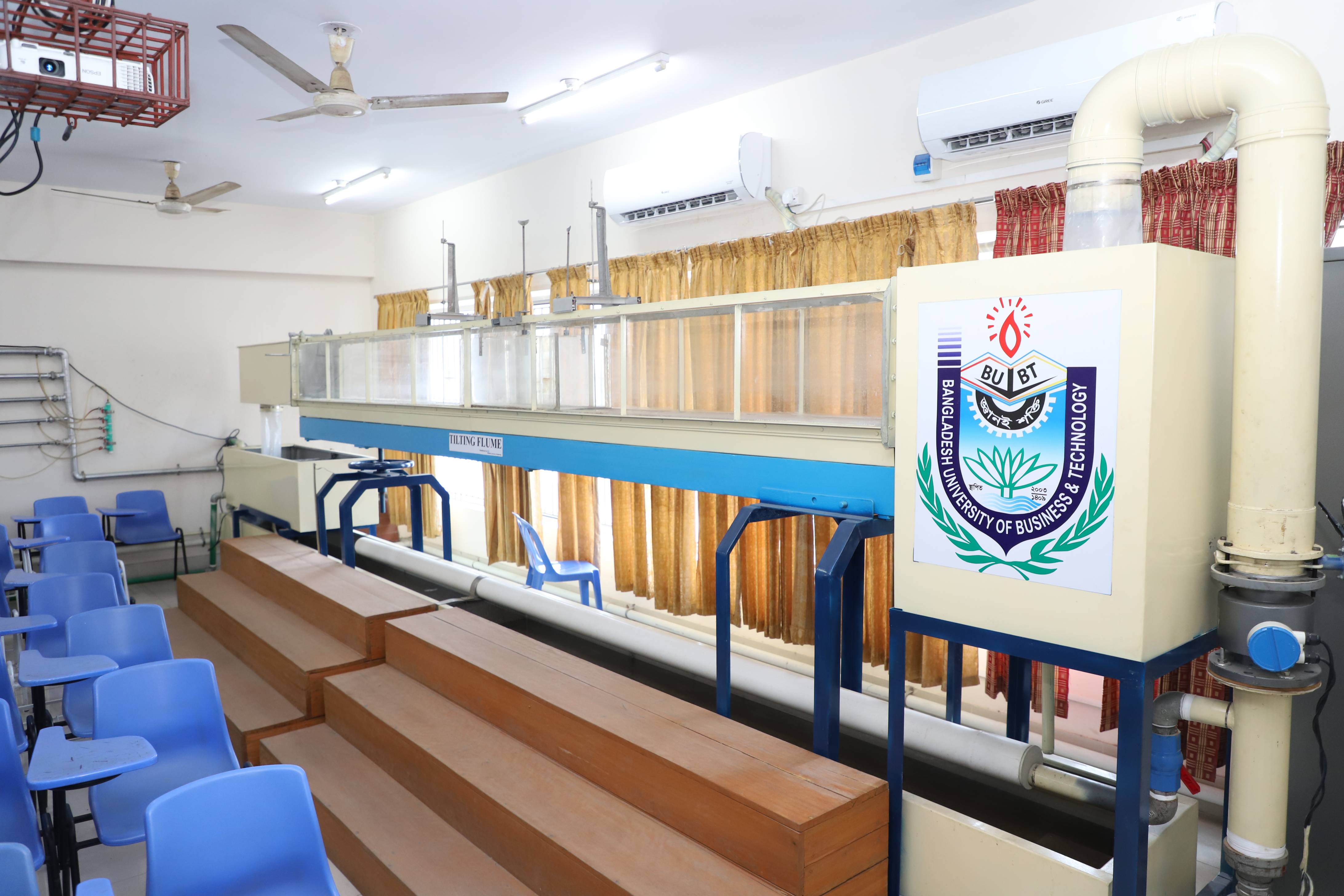
The Water Resources Engineering (WRE) Laboratory is a core undergraduate facility focusing on the experimental study of fluid mechanics and open-channel hydraulics. Equipped with modern testing apparatus, it gives students hands-on experience measuring and analyzing fluid flow, pressure distribution, head loss, and hydraulic structures. These practical exercises directly reinforce theoretical concepts from courses like Fluid Mechanics, Hydraulics, and Open Channel Flow.
About This Facility
Water Resource Engineering Laboratory
Department of Civil Engineering | BUBT
📌 Overview
The Water Resources Engineering (WRE) Laboratory is one of the core undergraduate laboratories of the Department of Civil Engineering, dedicated to the experimental study of fundamental principles of fluid mechanics and open-channel hydraulics. The laboratory is equipped with a hydraulic bench, a tilting flume, and a variety of hydraulic testing apparatus for experiments involving flow measurement, energy and momentum principles, pressure distribution, pipe flow, and hydraulic structures. It provides students with hands-on experience in conducting experiments on Bernoulli's theorem, Reynolds number, Venturimeters, Pitot tubes, weirs, flumes, sluice gates, pipe friction, and center of pressure, enabling them to observe and analyze the behavior of fluid flow under different hydraulic conditions. These practical exercises reinforce the theoretical concepts covered in courses such as Fluid Mechanics, Hydraulics, Water Resources Engineering, and Open Channel Flow.
🎯 Objectives
- Familiarize students with standard experimental procedures used to evaluate the fundamental principles of fluid mechanics and open channel hydraulics.
- Provide hands-on experience in operating hydraulic benches, tilting flumes, and a wide array of specialized flow measurement devices.
- Enable students to determine key hydraulic variables including pressure distribution, discharge coefficients, velocity profiles, and frictional head losses.
- Develop a practical understanding of open-channel phenomena such as hydraulic jumps, variations in bed slope, and flow control via gates and weirs.
- Bridge the gap between classroom theory and real-world engineering practice through guided laboratory investigations.
- Train students in accurate data recording, experimental analysis, and technical report writing.
🧪 Major Experiments
- Center of Pressure on a Submerged Plane Surface
- Verification of Bernoulli's Theorem
- Determination of Reynolds Number and Flow Regime
- Flow Measurement Using Venturimeter, Orifices, and Mouthpieces
- Flow Measurement over Weirs (V-Notch, Sharp/Broad-Crested)
- Flow Measurement Using Venturi, Parshall, and Cut-Throat Flumes
- Flow Beneath a Sluice Gate and Hydraulic Jump
- Determination of Head Loss Due to Pipe Friction
- Velocity Distribution and Discharge Measurement in Open Channels
📋 Machine Inventory
| Item Name | Qty |
|---|---|
| Tilting Flume Setup | 1 Set |
| Hydraulic Bench (Main Unit) | 1 Set |
| Sluice Gate Module | 1 Set |
| Venturi Flume | 1 Set |
| Broad-crested Weir | 1 Set |
| Parshall Flume | 1 Set |
| Cut Throat Flume | 1 Set |
| Bernoulli's Theorem Apparatus | 1 Set |
| Center of Pressure Apparatus | 1 Set |
| Orifice & Mouthpiece Unit | 1 Set |
| Venturimeter Apparatus | 1 Set |
| Pitot Static Tube Module | 1 Set |
| Sharp-crested Weir | 1 Set |
| Pipe Friction Apparatus | 1 Set |
| Reynolds Number Apparatus | 1 Set |
| V-notch Structure | 1 Set |
🛠️ Major Equipment Details & Functions
| Sl. | Equipment | Functional Description |
|---|---|---|
| 1 | Tilting Flume | Used to investigate open-channel flow characteristics, including flow profiles, hydraulic jump, and flow beneath sluice gates under different bed slopes. |
| 2 | Hydraulic Bench | A self-contained water supply unit that supports a wide range of hydraulic and fluid mechanics experiments with controlled water circulation and flow measurement. |
| 3 | Bernoulli's Theorem Apparatus | Demonstrates the conservation of energy in flowing fluids and verifies Bernoulli's equation by measuring pressure head variations. |
| 4 | Center of Pressure Apparatus | Determines the hydrostatic force and center of pressure acting on submerged plane surfaces. |
| 5 | Venturimeter | Measures the discharge of water flowing through a pipe based on the pressure difference between converging and throat sections. |
| 6 | Reynolds Number Apparatus | Demonstrates laminar, transitional, and turbulent flow regimes and determines the Reynolds number for fluid flow in pipes. |
| 7 | Pipe Friction Apparatus | Evaluates head losses due to friction in pipe flow and verifies the relationship between flow rate and friction loss. |
| 8 | Orifice and Mouthpiece Apparatus | Determines the coefficients of discharge, velocity, and contraction for flow through orifices and mouthpieces. |
| 9 | Pitot-Static Tube | Measures fluid velocity by comparing stagnation and static pressures in flowing water. |
| 10 | Weirs and Flumes | Includes Sharp-Crested, V-Notch, Broad-Crested, Venturi, Parshall, and Cut-Throat structures used for discharge measurement and open-channel flow analysis. |
| 11 | Sluice Gate | Demonstrates flow beneath a gate, contraction of flow, fluid dynamic controls, and energy dissipation profiles in open channels. |
🎓 Learning Outcomes
Upon successful completion of this laboratory course, students will be able to:
- Apply standard experimental methods to investigate the fundamental principles of fluid mechanics and open channel hydraulics.
- Operate hydraulic benches, tilting flumes, and hydraulic testing equipment safely and accurately.
- Measure and analyze key hydraulic parameters such as discharge, velocity, pressure, head loss, flow depth, and energy curves.
- Interpret experimental results related to pipe flow, open channel flow, hydraulic structures, and flow measurement devices, and compare them with theoretical predictions.
- Understand the practical applications of fluid mechanics and hydraulic engineering principles in the planning, design, and operation of water resources systems.
- Prepare clear, well-organized laboratory reports by accurately recording observations, analyzing experimental data, and discussing sources of structural or measurement error.
Location
Room: 806 Floor: 8, Building: 3, BUBT Main Campus
Capacity
25 Students
Equipment
Tilting Flume, Hydraulic Bench, Bernoulli's Theorem Apparatus, Center of Pressure Apparatus.
Other Facilities in Department of Civil Engineering
Laboratory Facilities
Our department features seven specialized labs complemented by interdisciplinary access to Physics,...
View Details
Structural Mechanics Laboratory
Located in Building 1, this lab features a 1000 kN Universal Testing Machine for strength testing st...
View Details
Engineering Materials Laboratory
Located on the ground floor of Building 1, this spacious facility is fully equipped for casting stru...
View DetailsCareer Opportunities
The Department of Civil Engineering at BUBT offers excellent career opportunities for graduates in t...

BUBT Civil Engineering Club
The BUBT Civil Engineering Club aims to enhance students' academic, professional, and personal devel...
View Details
Geotechnical Engineering Laboratory
The Geotechnical Engineering Laboratory is a core undergraduate facility dedicated to evaluating the...
View DetailsNeed More Information?
For more details about this facility or to schedule a visit, please contact the department.